Novatemp for pizza oven review (UK Buyer Notes)
UK guide to novatemp for pizza oven review: 50:1 optics, emissivity, safety stand-off, and when the NovaTemp Pro-1400 at £126.13 is a sensible trade buy —
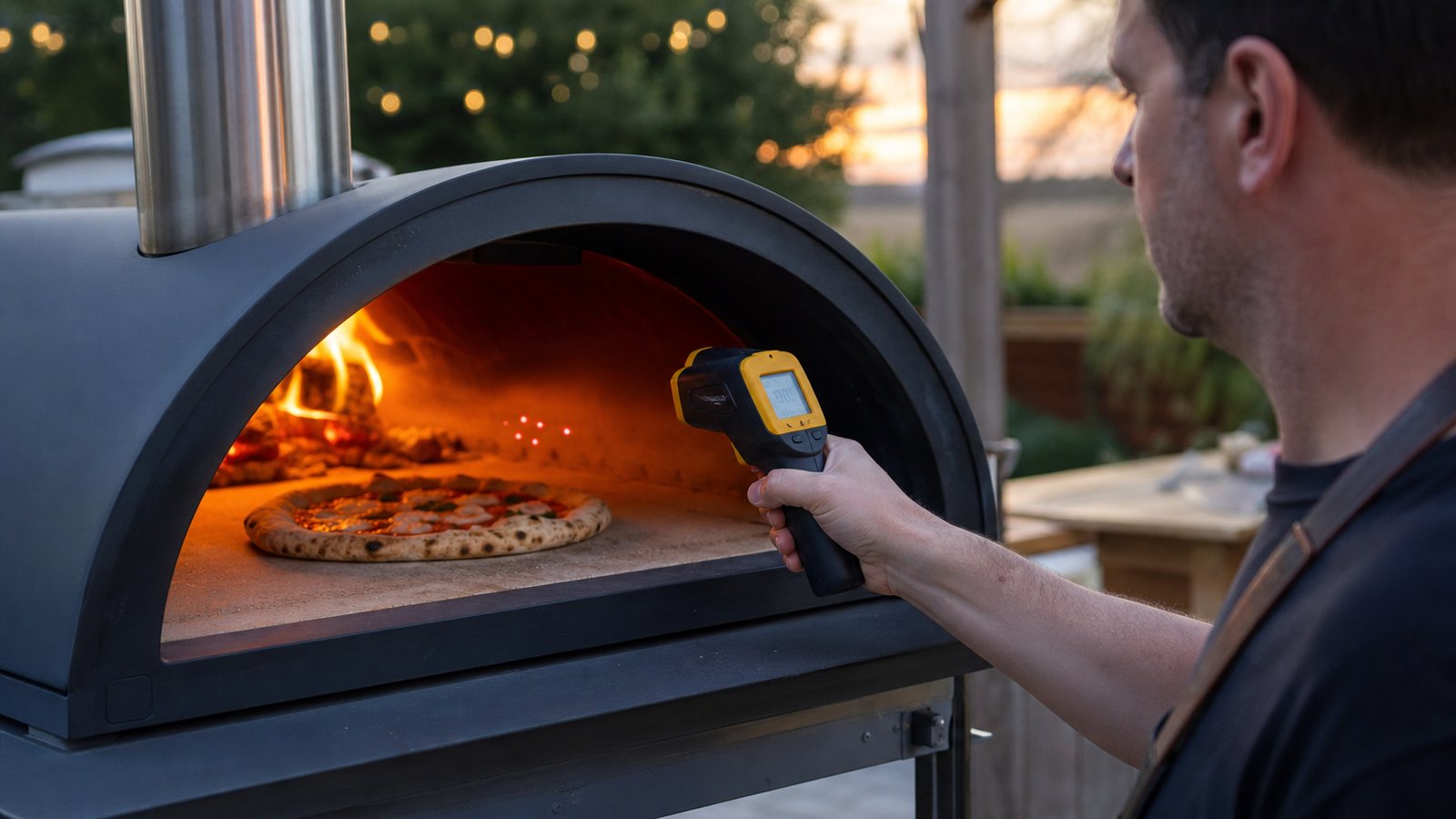
Looking up “novatemp for pizza oven review”? The NovaTemp Pro-1400 is a UK-sold industrial infrared surface thermometer (50:1 distance-to-spot, ring laser, adjustable emissivity, up to 1400°C) at £126.13 inc. VAT — useful for trade diagnostics, not medical body temperature.
Why this search usually shows up
People land on novatemp for pizza oven review when your pizza oven or dome regularly outruns a 550°C hobby gun and you want a safer stand-off from the mouth. The underlying need is repeatable surface temperature evidence at a safe distance — not another mystery number from a toy gun that drifts the moment you step back.
On the live NovaTemp site the Pro-1400 is positioned for damp cold-spot mapping, HVAC plant rooms, automotive exhaust work, pizza ovens and kilns, and general trade diagnostics. The published commerce price is £126.13 including VAT (£105.11 ex VAT), with free UK delivery and next-day dispatch claims from a UK warehouse. Ratings UI shows about 4.7/5 from 132+ reviews — treat those as site-stated marketing figures.
What the Pro-1400 actually claims
Stick to live facts:
- Maximum range 1400°C (2552°F)
- 50:1 distance-to-spot ratio (site example: 50 inches away → roughly a 1-inch circle)
- Multi-point ring laser aiming
- Adjustable emissivity via MODE (site examples include ~0.95 for brick/concrete; lower for shiny metals)
- Colour LCD with hold when you release the trigger
- Powered by an included 9V battery
- UKCA and CE compliance claims
- Commerce promise: 12-month UK warranty (older pack notes saying two years are outdated — confirm on checkout)
- 30-day returns under the Consumer Rights Act 2015
Product page: /detail/novatemp-pro-1400-infrared-thermometer/. Related reading on this site: /blog/fluke-alternative-infrared-thermometer-uk/.
Optics, emissivity and honest limits
Distance-to-spot is the unglamorous reason professionals upgrade. If the instrument’s measurement circle is larger than your target, you are averaging the target with everything around it. That is how a radiator valve “reading” becomes a wall reading, and how a manifold pipe becomes a heat-shield average.
Emissivity is the second trap. Shiny aluminium, polished stainless and fresh bright steel often under-read if you leave a masonry-style preset. Oxidised, painted or rough surfaces are usually kinder to IR. When a number disagrees with a contact probe, check surface condition before you accuse the gun.
unverified test: any claim that NovaTemp “matches Fluke accuracy”, “never drifts”, or hits a specific ±°C tolerance on every alloy should be verified against your own reference — those comparisons are not independently proven in this draft.
Pizza ovens punish short-range hobby guns. A 10:1 optic forces you nearer the mouth; a 550°C ceiling flashes HI on a hot dome. With a 50:1 ratio you can stand further back and still keep the measurement circle on the stone zone you care about. Set emissivity for stone or firebrick (often near 0.90–0.95) and remember stainless doors will under-read if left on a brick preset. Never lean into the oven mouth for a “better” number — the stand-off is the safety feature.
Industrial safety caveats (non-negotiable)
- Not medical. The site FAQ is explicit: this is not calibrated for human body temperature. Do not use it as a forehead or clinical thermometer.
- Laser aiming. Never point the laser at eyes or at reflective surfaces that can bounce into eyes. Treat it as an industrial aiming aid.
- Energised electrical equipment. An IR gun can screen for hot joints on closed equipment for qualified persons following lock-out/tag-out, PPE and employer rules. It does not authorise unsafe panel work.
- Hot processes. Forges, kilns, ovens and exhausts produce radiant heat and burn hazards. Use the 50:1 stand-off; wear appropriate PPE; do not lean into kiln mouths or engine bays to chase a prettier digit.
- Damp interpretation. Cold spots help you discuss condensation risk; they do not replace moisture metering, building pathology or a formal survey when the stakes are high.
More on shipping and returns: /legal/shipping-policy/. Broader site guide: /blog/how-to-use-an-infrared-thermometer-uk-explained-a-uk-buyers-/.
Practical field method
- Fit the 9V battery; keep a spare in the van.
- Squeeze the trigger to wake the colour display and ring laser.
- Set emissivity for the surface family you are measuring.
- Stand far enough that the 50:1 spot still fits on the target — then stop creeping closer out of habit.
- Take two or three readings and note the conditions (load, airflow, recent door openings).
- Release the trigger to hold the value while you write it down.
If you are comparing components (cylinders, calipers, phases, radiators), measure them in the same session with the same emissivity setting. Relative differences are usually more trustworthy than a single absolute.
Who should buy — and who should not
Good fit: heating engineers, mechanics, landlords/inspectors building a damp evidence pack, pizza-oven owners tired of HI errors, makers doing forge/kiln checks, and maintenance teams standardising handheld rounds.
Poor fit: anyone wanting a medical thermometer; anyone who needs a full thermal image for every inspection; anyone measuring only close-range kitchen tasks where a basic gun is enough.
If you already own a short-range 12:1 unit that keeps lying on small pipes, the upgrade case is optics and ceiling — not a logo. If your work is formal thermography, budget for a camera and use handheld IR as a triage tool.
Price and buying notes
Lead with the live basket figure: £126.13 inc. VAT. The detail page may also show higher comparison-style figures (seen around £157.66 / £201.81) — tell readers to verify the checkout total rather than inventing which number is “RRP”. Ex-VAT display of £105.11 matters for trade buyers who need invoices.
UK warehouse next-day dispatch and free delivery are site claims; cut-off times still apply for gift deadlines. Warranty wording to cite in content is the live 12-month UK commerce promise unless an order confirmation says otherwise.
FAQ
Is an infrared thermometer safe for damp surveys?
It is useful for finding cold surfaces where condensation is more likely, especially with a hygrometer. It is not a complete damp diagnosis on its own.
Can I use the Pro-1400 on pizza ovens or forges?
Yes for surface checks within the published 1400°C range, from a safe stand-off, with sensible emissivity. It is still not a substitute for process control thermocouples on critical heat-treat work.
What does 50:1 actually change on site?
It shrinks the measurement circle at a given distance versus common 12:1 hobby guns, which helps on valves, pipes and small electrical components — provided you aim carefully.
Is this a medical thermometer?
No. Do not use it for body temperature.
How does it compare with Fluke or Etekcity?
The site positions Pro-1400 as industrial-leaning specs at a mid price. Treat brand comparisons as shopping context; verify accuracy on your own references (unverified test).
What if I buy the wrong gift?
Site returns policy references a 30-day window under UK consumer law — check /legal/shipping-policy/ before you order.
Bottom line
For novatemp for pizza oven review, decide whether you truly need long-distance optics, high-temperature headroom and emissivity control. If you do, the NovaTemp Pro-1400 at £126.13 is a coherent UK trade option with clear live specs and ordinary consumer protections. If you do not, spend less and keep the budget for a moisture meter, hygrometer or thermocouple that matches the real job. Either way, respect laser, electrical and heat safety — the reading is never worth an injury.